Our own product
Veggie Radar: a produce price app with on-device photo recognition
Taiwan’s Ministry of Agriculture publishes daily wholesale produce prices, but nobody checks a government website before buying vegetables. Snap a vegetable and Veggie Radar shows today’s wholesale price, the recent trend and whether it is a good day to buy.
- Our own iOS app
- Consumer app, fresh produce shopping
- Taiwan
- 2026
- Live on the App Store in Taiwan, built in about 7 weeks
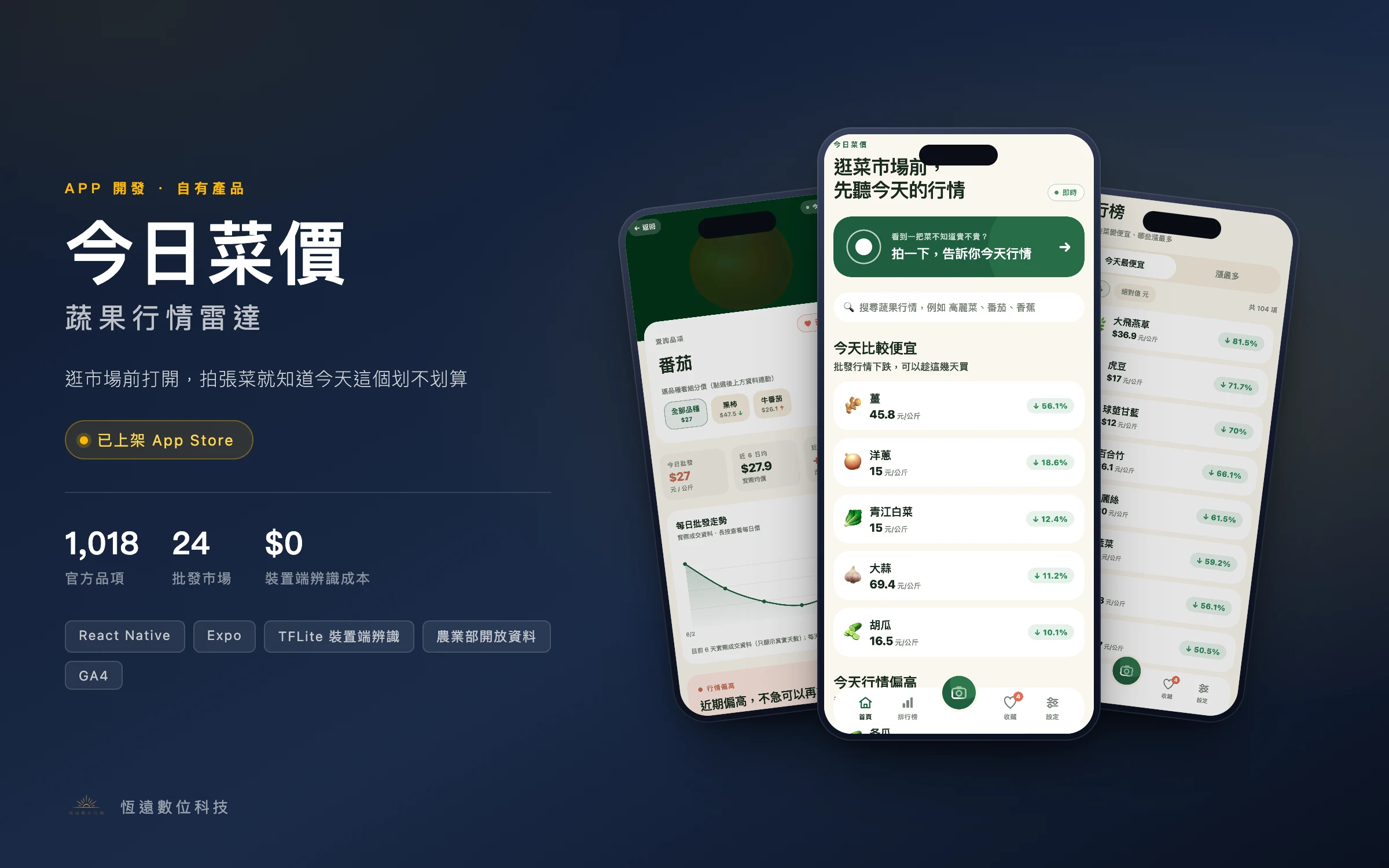
- 24 wholesale markets and 1,018 items in version 1.0
- On-device recognition: $0 cloud cost per scan
- On the App Store since July 20, 2026
Inside the system
We built this product for users in Taiwan, so the screens are in Traditional Chinese.
What was getting in the way
- The official API returns 3 MB (about 9,999 records) per call and took 18 seconds on a cold start, so the app’s 12-second timeout failed every time
- Official item names use a formal name plus a variety while shoppers use everyday names, and substring matching wrongly pulled kohlrabi into cabbage prices
- Cloud image recognition costs about $0.0006 per photo, which becomes a recurring expense when users scan several times a day
- Stall prices usually run 1.5 to 2.5 times wholesale, so a direct comparison would tell shoppers they overpaid
How the system solves it
- Timeout raised to 30 seconds, and the download goes into a local cache with a 6-hour TTL, so later launches read straight from the cache
- A table of everyday names maps what shoppers say to the official item name, matching uses prefixes instead of substrings, and a regression test pins it down
- Our own TensorFlow Lite model runs on the phone, so recognition never calls the cloud and works offline
- Every price is labeled as a wholesale reference, advice is always framed positively, and an automated test blocks negative wording
What is inside
Snap a photo, see the price
Take a photo of a fruit or vegetable and the phone identifies it, then shows today’s wholesale price, the trend over the last few days and whether to buy. No cloud connection needed.
Search by everyday names
Type instead of taking a photo. Aliases expand automatically, so the everyday word for cabbage finds the official listing. It is also the fallback when recognition fails.
Today’s good deals
The home screen shows two lists, cheaper today and pricier today, so a quick look before you head out tells you which stalls to visit.
Favorites and low-price alerts
Save the produce you buy often. The app rates the current price as low, medium or high against recent prices and sends a push notification when it drops low, with duplicates removed each day so alerts do not pile up.
Daily wholesale trend chart
Every item has a chart of its recent average wholesale price. For produce with several varieties, switch between them, and long-press to see a single day’s price.
Biggest movers
Ranks every item by today’s price change, by percentage or by amount, so you can see the whole produce market’s moves at a glance.
What changed
- Passed review and went live on the App Store on July 20, 2026, with version 1.0 covering 24 wholesale markets and 1,018 items
- With recognition on the phone, the cloud cost per scan fell from about $0.0006 to $0, and scanning works offline
- All 38 price pipeline tests pass, including the regression test for mismatched items and the guard against negative wording
How the project came together
Veggie Radar (今日菜價 in Chinese) did not start with technology. It started with a moment that happens every week and that nobody had solved. You are standing at a market stall looking at a bunch of greens, and you have no idea whether today’s price is reasonable. Taiwan’s Ministry of Agriculture publishes wholesale produce prices every day. The data is public and free, but nobody opens a government website and scrolls through more than 9,000 JSON records before buying vegetables.
Before building anything, we cut the scope. The first idea was a general “snap a photo, log the expense” app. Research showed that receipts were already covered: Taiwan’s e-invoice system, which records most store receipts electronically, was already served by the government’s own app and a private invoice app, and OCR expense tracking had long been mature in other countries. It was a crowded market. The real gap was purchases with no receipt at all, at street vendors and traditional markets. We also rejected the idea of photographing an item, comparing prices and telling you that you overpaid. There was no source for comparison prices, and telling people after the fact that they lost money only creates regret. So we settled on what the app is now: no price comparison, just a price radar that answers “what is cheap today, and should I buy it?” Narrowing the scope to fruits and vegetables also made recognition more accurate.
Three technical problems got in the way. The first was data. The official API returns about 3 MB and more than 9,000 records per call, and a cold start took 18 seconds in our tests. The app’s timeout was set to 12 seconds, so on a real phone the request always failed and the app fell back to its built-in sample data. We raised the timeout to 30 seconds and cached the download locally, so later launches load almost instantly. The second was names. The official list uses the formal Chinese name for cabbage plus a variety, roughly “brassica, early autumn,” while shoppers ask for cabbage by its everyday name. Substring matching made it worse: searching for the formal name also pulled in kohlrabi, a completely different vegetable whose Chinese name contains the same characters, and skewed the average price. Prefix matching fixed it, and a regression test now pins that case down. The third was cost. Cloud image recognition costs about $0.0006 per photo, and a few scans per user per day becomes a recurring expense. So recognition runs on the phone with our own TensorFlow Lite model. It never calls the cloud and works offline.
The product has one rule that cannot be broken. The API gives wholesale auction prices, and market stalls usually charge 1.5 to 2.5 times that, so the app never tells users they overpaid. Every price is labeled as a wholesale reference, and every suggestion is framed positively. The rule does not rely on discipline. It is an automated test: if the advice text contains words like “ripped off” or “overpaid,” the test fails. When recognition confidence is low, the app does not guess. It shows candidates and lets the user tap the right one, because a wrong suggestion hurts trust more than no suggestion.
For price history, the official API only covers a rolling four-day window, so we collect our own. A scheduled job fetches prices at a fixed time every day, aggregates them into a weighted daily average for each item and stores the result, and the app reads its history from there. Version 1.0 covers 24 wholesale markets and 1,018 items. From kickoff in June 2026, the app took about seven weeks to build, passed App Store review and went live on July 20, 2026.
- React Native 0.81
- Expo 54
- TypeScript
- react-native-fast-tflite (on-device recognition)
- expo-camera / expo-notifications
- Node.js + node-cron (daily price collection)
- MongoDB
- Ministry of Agriculture open data API
- GA4
Other systems we have built
Want a system like this for your team?
Tell us how your process works today. We will scope a version for your team, with a requirements document, a detailed quote and a timeline.