Case study
Quote management and tiered pricing software for a food distributor
The same product needed a different price for each of four customer tiers, and every cost or exchange-rate change meant updating quotes and catalogs by hand. We built one system that links cost, tiered pricing, approvals and a bilingual catalog.
- A food wholesale and trading company (client name withheld)
- Food import, export and wholesale
- Taiwan
- 2026
- In production, ongoing maintenance
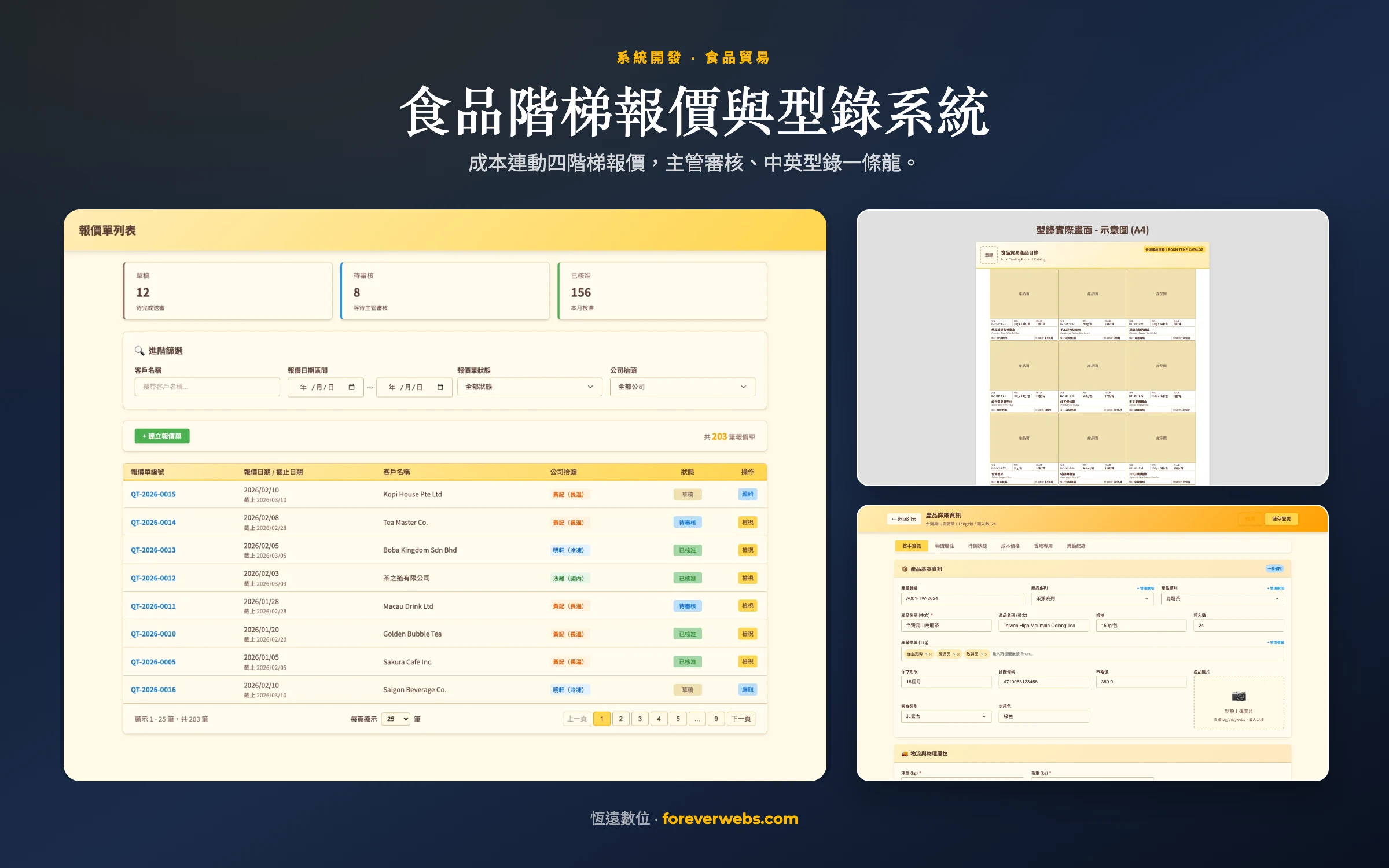
- Four customer tiers (A/B/C/D) priced automatically
- Field-level permissions for purchasing, sales and managers
- Bilingual catalog and labeling fees from the same product data
Inside the system
The client’s team works in Traditional Chinese, so the screens are in Chinese.
What was getting in the way
- The same product needed a different price for each of four customer tiers, and Excel quotes often used the wrong tier
- Every cost or exchange-rate change had to be copied into each quote and catalog by hand, and some were always missed
- Who could change prices, how markups were applied and who approved them all depended on verbal agreement
- The catalog had to exist in Chinese and English, maintained separately from internal quotes
How the system solves it
- A product cost library tied to four price tiers: pick the customer’s tier and the price fills in, with markups and labeling fees calculated live
- Costs and exchange rates kept in one place with change history, feeding quotes and catalogs from the same source
- Field-level permissions for three roles, plus manager approval, return or lock on every submitted quote, all recorded in an audit log
- A bilingual catalog with version management and per-customer exports, sharing product data with internal quotes
What is inside
Cost-linked four-tier pricing
Product costs tied to A/B/C/D customer tiers, with per-item markups, order markups and labeling fees calculated live.
Customer tiers and records
Each customer profile carries an A/B/C/D price tier that quotes apply automatically.
Manager approval and audit trail
Submitted quotes are approved, returned or locked by a manager, and changes to key fields are logged.
Role-based field permissions
Purchasing, sales and managers each get edit, read-only or no access per field, enforced in the interface and again on the server.
Bilingual catalog and export
Chinese and English catalog versions, exported per customer from the same product data as quotes.
Exchange rates and Hong Kong market fields
Exchange-rate management with history, plus Hong Kong market fields for cross-border quotes.
What changed
- Quotes moved from hand-built spreadsheets to a few clicks, and tier prices are calculated by the system instead of looked up
- Costs and exchange rates are updated once and flow into every quote and catalog
- Every quote goes through approval, return or lock, and every price change can be traced in the audit log
How the project came together
The client is a food wholesaler and trading company, and quoting took more effort than anything else. The same product carries a different price for each of four customer tiers (A, B, C and D). Sales staff priced everything by hand in Excel, which was slow, and customers were often quoted the wrong tier. Costs and exchange rates also change, and every change should reach every related quote and catalog. Updating them by hand meant a few were always missed, so the prices customers saw did not match actual costs.
We built a system that connects product cost, four-tier pricing, quotes, approvals and the catalog in one line. At its core is a cost-linked pricing engine: once purchasing updates a product’s cost, the system calculates all four price bands. Sales picks the customer’s tier and the right price fills in, with per-item markups, order-level markups and labeling fees calculated live. Costs and exchange rates are kept in one place with a full change history, and quotes and catalogs read from the same source.
For control, every field has permissions for three roles (purchasing, sales and managers) at three levels: edit, read-only or hidden. The interface hides what a role cannot use, and the server checks again. Each submitted quote is approved, returned or locked by a manager, and changes to key fields go into an audit log, so it is always clear who changed what, when, and who approved it.
The customer-facing catalog is kept in Chinese and English versions and exported per customer, using the same product data as internal quotes. Built-in exchange-rate management and fields for the Hong Kong market support cross-border quotes with different currencies and specifications.
- React 18
- Node.js / Express
- MongoDB (Mongoose)
- JWT
- bcryptjs
- Multer + Sharp
- Docker
- Zeabur
Other systems we have built
Want a system like this?
Tell us how your process works today. We will scope a version for your team, with a requirements document, a detailed quote and a timeline.