Case study
Equipment rental software with a booking calendar for a film production company
In equipment rental, value is tied to dates: the same gear is booked, repaired and sublet at different times, so availability has to be recalculated every day. We built a booking calendar and a live availability engine that loads thousands of bookings in seconds and flags conflicts automatically.
- 仙人掌影業有限公司, a film production and equipment rental company
- Film production and equipment rental
- Taipei, Taiwan
- 2025
- Hundreds of equipment items
- In production, ongoing maintenance
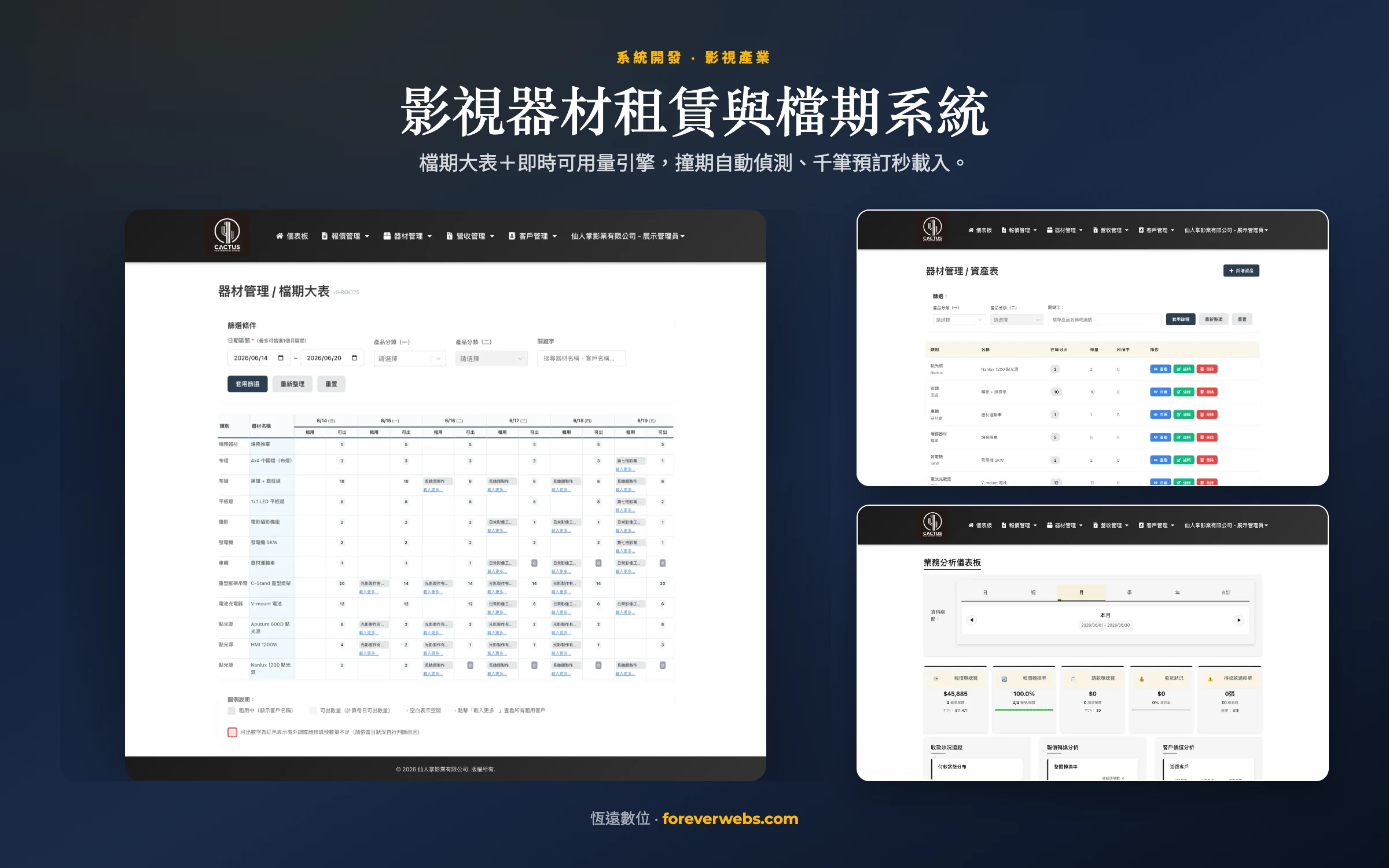
- Booking calendar with thousands of bookings: from timing out to seconds
- Daily availability net of repairs, retired, booked and sublet units
- 30+ equipment categories fully scheduled
Inside the system
The client’s team works in Traditional Chinese, so the screens are in Chinese.
What was getting in the way
- The same gear goes to different crews on different dates, and scheduling in Excel led to double bookings in busy season
- Real availability has to subtract repairs, retired, booked and sublet units, and repairs have start and end dates, so manual counts were often wrong
- When stock ran short, sublet items got mixed into in-house stock and availability was miscalculated
- Early-morning pickups crossing the time-zone boundary were recorded a day off, leaving bookings unlocked
How the system solves it
- A booking calendar (equipment by date) with live conflict detection, showing bookings, customers and sublets for every day
- A live availability engine that recalculates daily, with repairs recorded by date range and returned to stock automatically
- Out-of-stock items added to a quote become sublet lines automatically, with sublet cost kept separate from rental income
- Every date in the stack anchored to Asia/Taipei to eliminate off-by-one-day errors
What is inside
Equipment booking calendar
An equipment-by-date grid showing bookings, customers and sublets for each day, with category and keyword search. Thousands of records load in seconds.
Live availability engine
Calculates total minus repairs, retired, booked and sublet units every day, and flags conflicts as orders are entered.
Date-range repair tracking
Repairs have start and end dates, are deducted day by day and return to stock on their own, with no manual “repair done” step.
Automatic sublets for out-of-stock items
Picking an item with zero stock creates a sublet line, with sublet cost and rental income calculated separately.
Time-zone-safe dates
Every date is anchored to Asia/Taipei, fixing pickups that used to be recorded a day early.
Rental quotes by category
30+ equipment categories priced by rental days, with category discounts and mixed tax handling.
What changed
- The booking calendar went from timing out to loading in a few seconds with hundreds of items and thousands of bookings
- Filtering equipment by category went from more than 30 seconds to about a second
- Repairs, sublets and bookings now feed daily availability automatically, and conflicts are flagged when orders are entered, sharply reducing double bookings
“A very young, very efficient and very dedicated team, and a very professional one.”
How the project came together
The client runs a film production and equipment rental business with hundreds of lighting, camera, power and grip items in more than 30 categories. Rental is different from selling because value is tied to dates. The same set of lights goes out to different crews on different dates, and staff need to know at any moment how many units are still free for a given range. Real availability also has to subtract units under repair, already rented out, retired, or temporarily sublet in from other suppliers. All of this used to live in Excel and in people’s heads, so double bookings were common in busy season. Repairs could only be recorded as a single number, which also reduced availability on past dates, and units had to be added back by hand once they were fixed.
We built the system around scheduling. The centerpiece is a booking calendar: equipment as rows and dates as columns, showing at a glance which order and which customer has each item on each day, and where sublet units are filling gaps. Staff check for conflicts before they write an order. Behind it, a live availability engine calculates each day’s available quantity as total minus repairs, retired, booked and sublet units, and flags conflicts as orders are entered. Repairs are records with start and end dates, so the system deducts them day by day and returns the units to stock automatically when the repair period ends. When stock runs out, staff can add the out-of-stock item to a quote with the quantity they need, and the system turns it into a sublet line with its cost tracked separately from rental income.
A few engineering problems were harder than they looked. Time zones: with the server running on UTC, a 9 a.m. pickup on June 19 in Taiwan was recorded as the previous day, which left bookings unlocked. We anchored every date in the stack to Asia/Taipei and the off-by-one-day errors went away. Performance: with hundreds of items and thousands of bookings, the calendar used to time out. We rewrote the algorithm to run in linear time using prebuilt indexes and precomputed date keys, which brought loading down to a few seconds, and protected it with pure functions and large-data tests. Filtering the equipment list by category took more than 30 seconds because fuzzy matching could not use an index. It now tries an exact, indexed match first and falls back to fuzzy matching only when needed, with a query time limit, so even thousands of records come back in about a second.
AI stays an assistant here too. Rules handle everything they can calculate, and AI only turns loosely worded requests into a quote outline that staff complete with equipment and dates.
- React 18
- Node.js / Express
- MongoDB
- OpenAI
- Anthropic Claude
- jsPDF / html2canvas
- @dnd-kit
- Jest
- Docker
- Zeabur
Other systems we have built
Want a system like this?
Tell us how your process works today. We will scope a version for your team, with a requirements document, a detailed quote and a timeline.