Case study
Quality management software (QMS) prototype for an electronic components manufacturer
Most e-approval tools stop once a quality form is signed, and nobody checks whether the actions were carried out. In 10 working days we built an interactive prototype: 13 clickable screens with four-stage sign-off and item-level follow-up on overdue actions.
- A multinational electronic components manufacturing group (client name withheld under an NDA)
- Electronic components manufacturing
- 2026
- Eight plants and eleven quality standards in parallel
- Interactive prototype, built in 10 working days
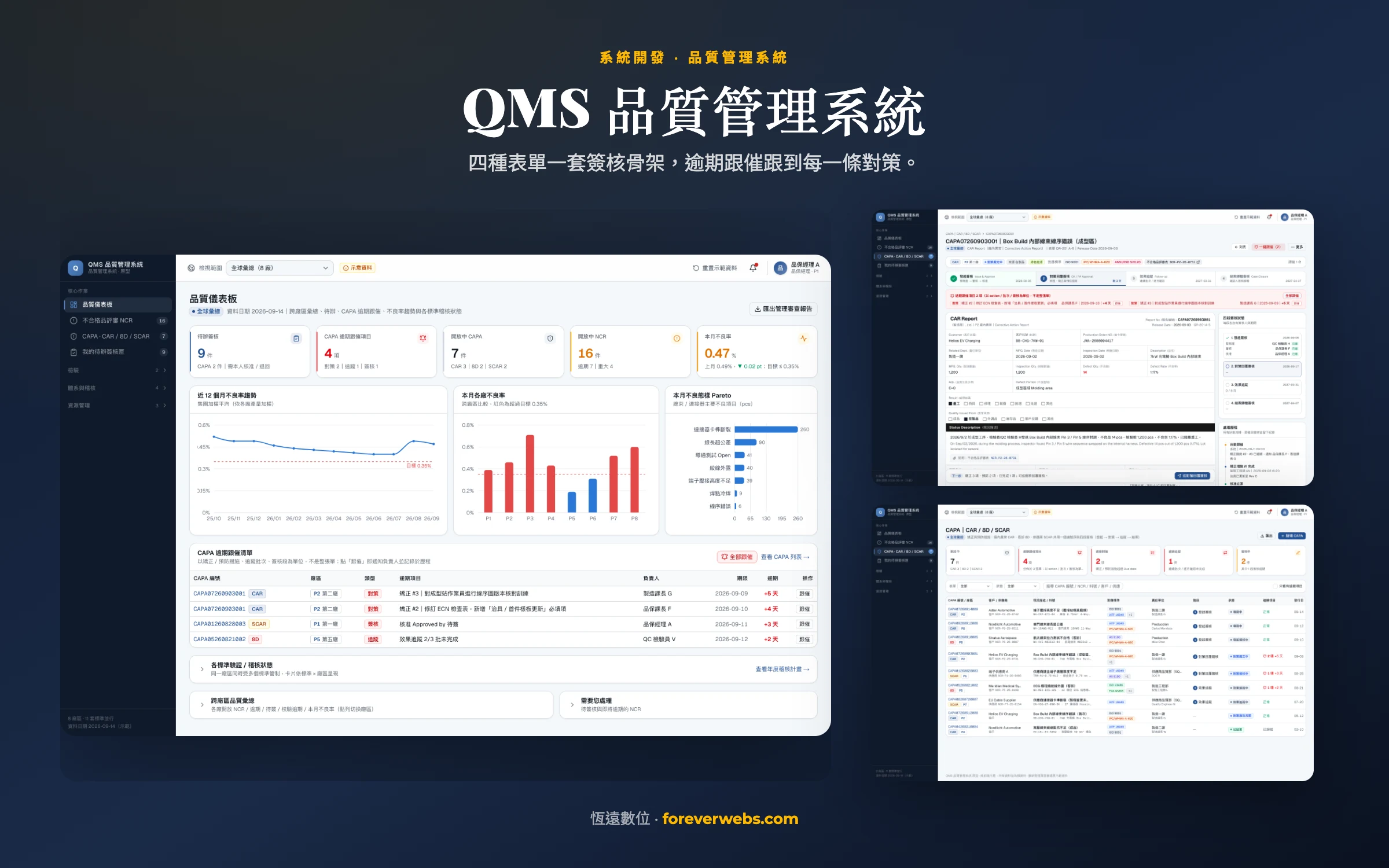
- 13 clickable screens
- Built in 10 working days
- 11 quality standards in parallel
Inside the system
The client’s team works in Traditional Chinese, so the screens are in Chinese.
What was getting in the way
- Quality issue records were split across paper, Excel and an e-approval system, so one case meant checking three places, and a missing form would go unnoticed
- CAPA, CAR, 8D and SCAR forms differ in layout and recipient but share the same sign-off and tracking structure, and four separate systems would be impossible to maintain
- Eight plants answer to eleven standards at once, so one nonconformance report has to cover the fields that ISO 9001, IATF 16949 and ISO 13485 each require
- Most e-approval systems stop at “signed,” with nobody checking whether actions were carried out or whether they worked, which is how cases stay open for two years
How the system solves it
- One sign-off framework with routing by source: pick the source when opening a case, and the form switches to the CAR, 8D or CAPA Report layout on the same four-stage sign-off
- Follow-up down to each action, each tracking batch and each sign-off stage, so a reminder can say “Action 2, which you own, was due last Friday”
- The person who opens a case chooses whether effectiveness is tracked by batch or by time, instead of a hard-coded rule, so the shop floor has no reason to work around the process
- Form layouts match the current paper forms and the 8D report stays in English, so exported PDFs go straight to customers and line up with older records during audits
What is inside
Four-stage sign-off
Initiation, corrective action response, effectiveness tracking, and closure and archiving, each stage with its own approvers and deadline.
Routing by source
Pick the source when opening a case and the form switches to the CAR, 8D or CAPA Report layout, all on one shared sign-off framework.
Item-level follow-up on overdue actions
Follow-up covers each action, each tracking batch and each sign-off stage, so reminders name exactly which item is overdue.
Multiple plants and standards
Eight plants and eleven standards in parallel. One record can carry several standard tags, so an audit pulls all the matching evidence at once.
Chinese and English forms
Layouts match the current paper forms, the 8D report stays in English for customers, and the interface language is set separately from the form language.
Quality dashboard
Defect-rate trends across plants, a Pareto chart of defect types and the list of overdue CAPA follow-ups, all on one page.
What changed
- 13 clickable screens in 10 working days, so the requirements meeting went through the specification line by line on a working system
- One demo settled the fields, approval stages and tracking rules for all four forms, and produced a specification ready for development
- The prototype became the basis of the quote: every line item maps to a real screen
How the project came together
This is an interactive prototype of quality management software for the quality assurance team at a manufacturer. The client is a multinational electronic components manufacturing group with eight plants, and it stays anonymous under a nondisclosure agreement. Company, plant, staff and supplier names in the screens have all been replaced with placeholders, and all data shown is sample data.
Here is what quality teams run into most often. Records of quality issues are split across paper, Excel and an e-approval system, so checking one case means looking in three places. A single corrective action takes four rounds of sign-off and months of follow-up from opening to closing, and most e-approval systems stop once the form is signed. After that, nobody checks whether the actions were carried out or whether they worked, and there is nowhere to look it up. That is how a plant ends up with cases still open two years later.
Our approach was to put all four form types on one framework. CAPA, CAR, 8D and SCAR forms (corrective and preventive actions, corrective action requests, 8D problem-solving reports and supplier corrective action requests) have different layouts and go to different people. The 8D report goes to the customer, so it stays entirely in English. The sign-off and tracking logic, though, is the same for all of them. When opening a case, the user first picks its source, and the form switches to the matching layout. Underneath, every form shares the same four-stage sign-off: initiation, corrective action response, effectiveness tracking, and closure and archiving.
What really decides whether a system like this gets used is how fine-grained the follow-up is. We track follow-up down to each action, each tracking batch and each sign-off stage. That way a reminder can say “Action 2, which you own, was due last Friday,” and the manager’s dashboard can show numbers people can act on right away, such as “7 actions are overdue across 3 departments.”
The prototype took 10 working days and has 13 clickable screens. We brought a working system to the requirements meeting and went through the specification line by line on screen. One demo settled the fields, approval stages and tracking rules for all four forms, and right after the meeting we produced a specification ready for development. The prototype also became the basis of the quote: every line item maps to a real screen.
- Next.js
- TypeScript
- Tailwind CSS
- shadcn/ui
Other systems we have built
Want a system like this?
Tell us how your process works today. We will scope a version for your team, with a requirements document, a detailed quote and a timeline.