Our own product
Rental property management software with tenants on LINE
Rent, meter readings and repairs used to live in Excel sheets and LINE group chats. We put them in one piece of software that draws every building as a house, so the rooms that need attention stand out at a glance, while tenants handle bills, payments and repairs in LINE.
- Our own product (offered in Taiwan as 秒租管家), built to be customized for property managers
- Property management (our own product)
- Taiwan
- 2026
- From a landlord with one unit to managers running many buildings
- In active development
- 5 tenant features, all in LINE
- 3 legal lease limits checked automatically
- 63 end-to-end tests green three runs in a row
Inside the system
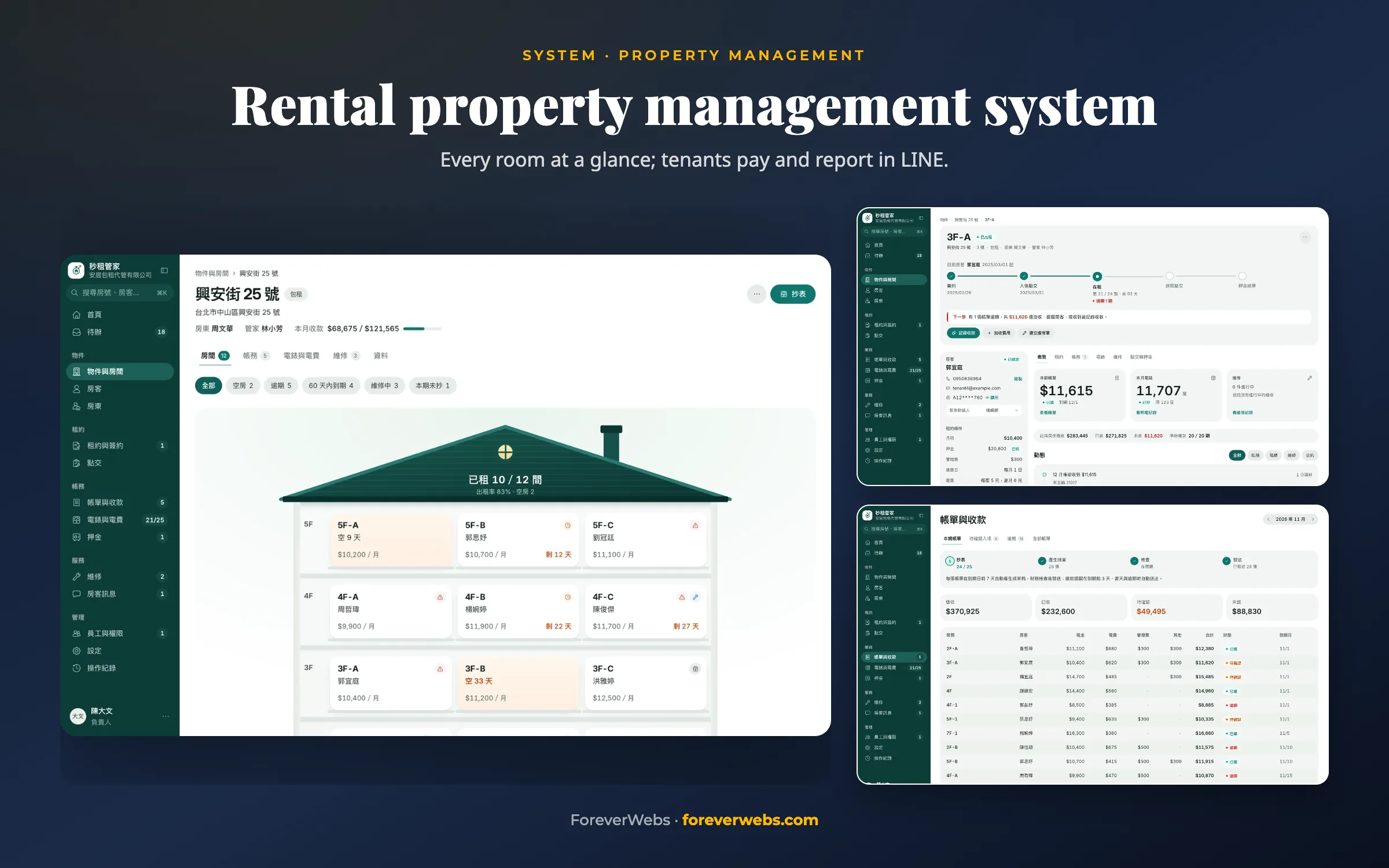
We built this product for users in Taiwan, so the screens are in Traditional Chinese.
What was getting in the way
- Room status is scattered across Excel and managers’ phones, so finding vacancies, overdue rent and expiring leases means checking several places
- Meter readings, power charges and bills are done by hand, and matching transfers means going through them one by one
- Tenants ask managers about bills and repairs, and the messages get lost in LINE group chats
- One unit and dozens of rooms need very different tools, and off-the-shelf software is either too complex or too basic
How the system solves it
- Draw every building as a house, color each room by status and filter vacant, overdue or expiring rooms with one tap
- Work out power charges from phone meter readings, generate bills every month, and confirm each payment after the tenant reports the transfer digits
- Let tenants see bills, report payments, request repairs and read their lease in LINE, with messages collected for the manager to answer
- Split access by role, and turn the home page into “Your home” when an account has only one unit
What is inside
Rooms drawn as a house
Each building is drawn floor by floor, vacant, overdue and expiring rooms are colored, and a filter lights up only the rooms that need attention.
Online signing with lease checks
Leases follow the official template, with checks on the deposit, review period and electricity rate cap before the link goes to the tenant.
Bills and payment confirmation
Bills are generated every month, tenants report the last five digits of their transfer in LINE, and finance confirms or returns each one.
Meter reading on the phone
Take a photo of the meter, then type the reading. Unusual usage asks for a second look, and readings are kept offline until there is a signal.
Repairs and deposit settlement
Tenants request repairs in LINE and technicians report completion through a login-free link. At move-out, deductions go into a settlement the tenant confirms.
Single-unit landlord mode
When an account has only one unit, the home page is “Your home”: tenant, bill, power and next step on one page.
What changed
- Room status sits in one picture of the building, with no more cross-checking Excel for vacancies and overdue rent
- Meter reading, bill generation, review and sending happen in 4 steps on one page, and each tenant payment report is confirmed one by one
- Before launch it passed 644 unit tests and 63 end-to-end tests (including permission and malicious-input cases), green three runs in a row
How the project came together
Rental management companies in Taiwan often look after several buildings and dozens of rooms, and the monthly routine is much the same everywhere: read the electricity meters, work out the power charges, issue bills, match bank transfers, chase late payments, and deal with repair requests and move-out inspections as they come up. Most of them get by with Excel, LINE group chats and paper receipts, so the data sits on each manager’s phone. Finding out which room owes rent or which lease is about to end means checking several places, and when a tenant asks how much this month’s bill is, the manager has to stop and look it up.
We put that routine into one system. Every building is drawn as a house, floor by floor, so vacant rooms, overdue rent, leases about to end and rooms under repair are visible at a glance, and one tap on a filter lights up only the rooms that need attention. A room page keeps the room details, lease, bills, meter, repairs and inspection records together, with the next step written at the top. Leases follow the official residential lease template, with automatic checks on the deposit, the review period and the electricity rate cap, and the signing link goes to the tenant for online signing. Monthly bills are generated automatically, tenants receive them in LINE and report the last five digits of their transfer, and the finance team confirms each payment from a to-do list. Managers read meters on their phones, taking a photo first and typing the reading on a large number pad, and readings are saved even without a signal. Deposit settlements, repair dispatch and an AI assistant that answers common tenant questions live in the same place.
Access follows roles (owner, manager, finance), and a manager can see only the buildings they look after. A landlord with a single unit opens straight to “Your home” instead of the full back office. The operator back office and the tenant screens are complete, and the system can be customized to a company’s property types, charges, signing and reconciliation process, and connected to other systems as needed.
- Next.js
- React
- TypeScript
- Node.js
- LINE API
- Anthropic
- Tailwind
Other systems we have built
Want a system like this for your team?
Tell us how your process works today. We will scope a version for your team, with a requirements document, a detailed quote and a timeline.