AI automation
AI Customer Service Agent: What to Automate, What to Keep Human
An AI customer service agent cut one e-commerce brand's average response time from 4 hours to 3 minutes. What to automate first, what to keep human and how to roll it out.
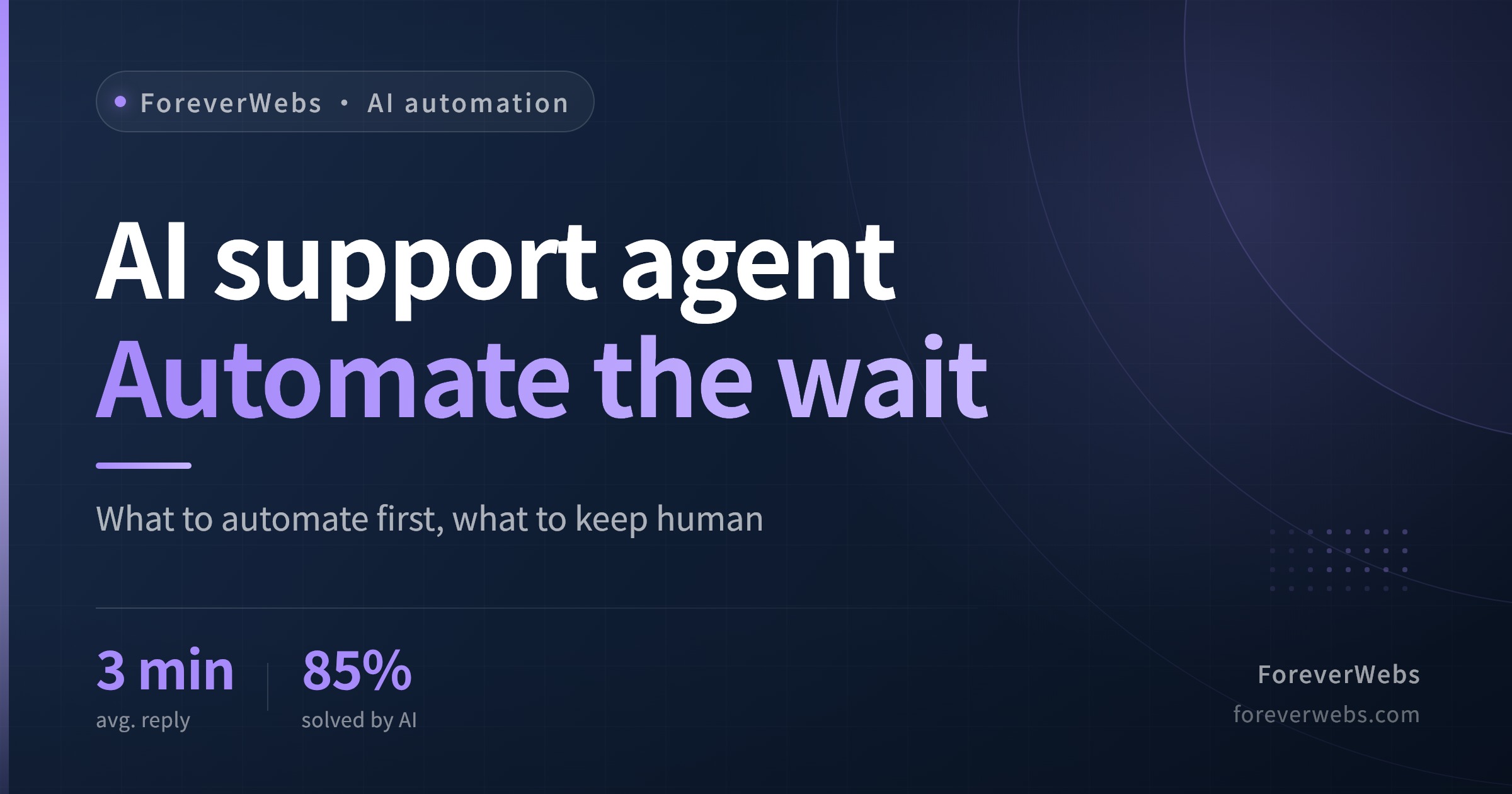
Five support agents were answering hundreds of customer messages a day for an e-commerce brand in Taiwan with more than 200,000 members. They answered every message by hand through the brand's LINE official account (LINE is the main messaging app in Taiwan). At peak times, customers waited four hours on average, and the wait cost sales and brought in bad reviews. More than 70% of the messages were repeat questions about order status, shipping and returns. Nobody answered in the evening or on weekends.
We built an AI customer service agent for that inbox. It answers 12 categories of common questions from templates the support lead maintains. Anything it cannot resolve goes to a person with the full conversation attached. Average response time fell from 4 hours to 3 minutes, and the AI resolves 85% of inquiries on its own (full case study).
Our view after that project is simple. An AI customer service agent should answer only from content your team has approved, and it should hand off early. Its job is to remove the waiting. The judgment stays with your people.
What an AI customer service agent should handle first
Start with questions that have one right answer your team has already written down: order status, shipping, return steps and product facts. Anything involving money, an exception or an upset customer stays with a person.
Message type | Who handles it | Why |
|---|---|---|
Order status, tracking, shipping times | AI agent | One right answer in your system or policy |
How to return or exchange | AI agent | Fixed steps your team already wrote |
Product facts: size, material, compatibility | AI agent | The answer is in your catalog |
Refunds, credits and policy exceptions | Person | Money leaves the business |
Complaints and upset customers | Person, flagged early | Needs empathy and discretion |
Damaged goods, safety issues, legal threats | Senior person | High risk, needs a decision on record |
Large orders and high-value customers | Person | The relationship is worth more than speed |
Anything the agent is unsure about | Person | A short wait costs less than a wrong answer |
The split matters because customers are wary of AI in support. In a Gartner survey of 5,728 customers, 64% said they would prefer that companies not use AI for customer service. Their top concern, cited by 60%, was that AI would make it harder to reach a person. Fast answers with a person easy to reach speak to exactly that concern.
An AI customer service chatbot answers questions. An agent can also act: look up an order, start a return, open a ticket. Each action you allow is one it can get wrong at 2 a.m. with nobody watching, so start that list short.
The e-commerce brand drew its line the same way: a sentiment check flags high-risk conversations and routes them to senior agents first.
How the knowledge base, rules, AI agent and handoff fit together
An AI customer service agent is one part of a four-part system: the knowledge base, rules, the AI itself and a human handoff. Each part needs an owner, and when one is weak, the others cover for it badly.
Part | What it does | Who owns it | What breaks without it |
|---|---|---|---|
Knowledge base | Holds approved answers, policies and product facts | Support lead | The AI fills gaps by guessing |
Rules | Decide clear-cut cases: order lookups, return windows, escalation | Support lead, built by engineers | The AI makes calls a rule should make |
AI agent | Reads the message, finds the intent, words the reply | Engineering | Customers fight menus and keywords |
Human handoff | Passes the thread, a summary and the customer's mood to a person | Support team | Customers repeat themselves and get angrier |
The knowledge base decides what the agent may say
In the e-commerce project, the support lead edits FAQs, answer templates and product information in a console. The AI picks up changes right away, with no engineer involved. Before the project, answers varied from agent to agent. Now routine answers come from one approved source. Write each answer the way your best agent would say it, and give it an owner and a review date.
Rules first, then the AI
Anything a rule can decide should be decided by a rule. Order status comes from your order system (Shopify, for example, through its API), and the AI only puts it into a sentence. Return eligibility is a date check. Our own hiring software works the same way. An application with no resume and fewer than 50 characters about relevant experience is rated low without calling the AI at all (how that system works).
The AI takes what rules cannot: messages typed in a hurry, with typos and two questions in one. When nothing in the knowledge base fits, its move is a handoff, never a guess.
The handoff decides how customers remember you
A good handoff feels like a transfer to a colleague who has read the whole thread. In the e-commerce project, the person gets the conversation with a summary and a sentiment reading attached. Hand off early. A handoff rate that runs a little high in the first weeks costs less than an agent that guesses, and each handoff shows you a missing answer.
The numbers that show whether AI customer service automation works
Track four numbers from day one: response time, resolution rate, handoff rate and customer satisfaction. Read them together, because any one of them can look good while customers are unhappy.
Number | How to measure it | In the e-commerce case | Warning sign |
|---|---|---|---|
Response time | Time from a message to the first useful reply | 4 hours to 3 minutes on average | Fast replies that answer nothing |
Resolution rate | Share of conversations the AI closes with no person involved | 85% | Customers who gave up, counted as resolved |
Handoff rate | Share of conversations passed to a person | 15% | Near zero, which can mean guessing |
Customer satisfaction | Post-chat rating, AI and people scored separately | 3.6 to 4.9 out of 5 | Only happy customers answer the survey |
Measure a baseline before launch, or the first review becomes an argument about impressions. The e-commerce brand knew its four-hour average wait, so the drop to 3 minutes was plain to see.
Define "resolved" strictly. A customer who stopped replying may have given up. Count a conversation as resolved only when the customer confirmed the answer or did not come back about the same issue within a few days.
Read the handoff rate from both sides. Near zero can mean the agent answers what it should pass on. A high rate usually points to gaps in the knowledge base, and the queue lists them.
Then connect the numbers to the business. In the e-commerce case, negative reviews fell 70%. The brand tracks all four numbers on one live dashboard, a habit worth copying.
Risks of an AI customer service agent, and how to contain them
Three risks need design work before launch: wrong answers, money leaving the business and customer data. You contain each one by deciding what the agent may see, say and do.
Risk | What it looks like | How to contain it |
|---|---|---|
Wrong answers | The agent states a policy that doesn't exist | Approved content only; hand off when nothing matches |
Refunds and credits | A customer talks the agent into a refund | The agent gathers details; a person approves any money |
Manipulation | A message tells the agent to ignore its instructions | Treat customer text as data; flag it for a person |
Privacy | Transcripts hold names, addresses and order history | Collect the minimum, mask card numbers, limit retention, check vendor terms |
Wrong answers
Customers will hold you to what your agent says. In February 2024, British Columbia's Civil Resolution Tribunal in Canada ruled against Air Canada. Its website chatbot had told a passenger he could claim a bereavement discount up to 90 days after buying a full-price ticket, which was not the airline's policy. Air Canada argued, in effect, that the chatbot was responsible for its own actions. The tribunal disagreed and ordered the airline to pay CA$812.02, including CA$650.88 in damages. That is one small-claims ruling in Canada, and this is not legal advice. The lesson travels anyway: whatever your agent says, your company said.
Refunds and manipulation
An agent should never approve money on its own. Let it collect the order number, the reason and photos, check the return window by rule and prepare the case. A person clicks approve.
People will test that limit. In a late-2025 stress test set up with Anthropic, The Wall Street Journal let an AI agent built on Claude run its newsroom vending machine for three weeks. The agent ordered stock, set prices and answered customers in Slack. Reporters persuaded it to give away nearly all of its inventory, including a PlayStation 5 it had been talked into buying "for marketing purposes." A second version answered to an AI "CEO" agent. That held until a reporter produced fake board-meeting notes, and everything was free again. The Journal reported that the experiment lost hundreds of dollars.
OWASP ranks this kind of attack, prompt injection, first in its Top 10 for LLM applications (2025). Its mitigations include least privilege and human approval for high-risk actions. Our hiring software applies the same defense: a resume PDF that hides instructions for an AI is never sent to the AI and is flagged for a person. Treat support messages that give the agent orders the same way.
Privacy and disclosure
Chat transcripts are customer data, and two California rules are worth knowing (this is not legal advice). If your business is covered by the California Consumer Privacy Act, California residents can ask what personal information you hold about them and ask you to delete it. That can include chat transcripts. California's bot disclosure law has been in effect since 2019 (Business and Professions Code section 17941). It makes it unlawful to use a bot online to mislead people in California about its artificial identity to drive a sale. A clear disclosure removes liability under that section. Disclose everywhere, and keep a person easy to reach.
A phased rollout plan for your AI support agent
Roll out in four phases, and move on only when the current phase's numbers hold. Each phase gives the AI a little more to do and keeps a person on everything else.
Phase | What the AI does | What people do | Move on when |
|---|---|---|---|
Prepare | Nothing live yet | Sort past messages by topic, approve answers, set handoff rules | The top topics have approved answers |
Shadow | Drafts replies to real messages, sends nothing | Send, edit or reject each draft | Most drafts need little or no editing |
Live on top topics | Answers the top topics, hands off the rest | Work the handoff queue, fix answers weekly | Resolution and satisfaction hold steady |
Expand | Adds topics, channels, after-hours coverage and approved actions | Approve refunds and exceptions | Each addition passes its own shadow test |
Start with your own messages: export a few months of conversations and sort them by topic. The few topics that carry most of the volume are your first release. In the e-commerce case, that meant order status, shipping and returns.
Shadow mode is cheap insurance. The agent drafts, your team decides, and every bad draft becomes a knowledge base fix before a customer sees it. We take the same care with systems. When we connect AI to a client's tools, we connect read-only first and observe for a week before the AI may write anything.
Then widen the hours. Evenings and weekends can hold the biggest payoff if nobody covers them today. The e-commerce brand saw conversion on after-hours orders rise 40% once answers were available around the clock.
Add actions last. Looking up an order is low risk. Starting a return is medium risk. Refunds stay with a person.
What the support team does once the AI agent is live
The team stops retyping the same answers and spends its time on conversations that need judgment.
In the e-commerce case, the team did shrink, from five agents to two, and staffing costs fell 60%. Look at what the two people do now: they focus on high-value customers and complex cases. The AI took the waiting and the retyping. The judgment stayed with people.
We still would not start an AI project with a headcount target. Gartner predicts that half of the companies that cut customer service staff because of AI will rehire by 2027, for similar work under different job titles. Set the goal as "no customer waits for an answer we already have," and let staffing follow the handoff queue.
Three jobs need a named owner after launch:
- Knowledge base owner: usually the support lead, who reads the week's handoffs and fixes answers.
- Escalation owner: a senior person for flagged, high-risk conversations.
- Metrics owner: reviews the four numbers weekly and decides what the agent takes on next.
Buy an AI agent or build one around your systems
If your questions are standard and your help desk already offers an AI agent, start there. Build around your own systems when the agent must follow rules no template supports, act inside your order system or keep your data under your control.
Packaged agents are often billed per seat or per resolved conversation. At hundreds of messages a day, model a full year of fees and check how the vendor defines a resolution. A custom build earns its cost when your return rules have exceptions, several channels need one inbox, or you want to own the code and the data. For the wider trade-offs, see custom software development for small businesses.
The same split, with AI drafting and a person approving, works for quotes too. See AI quoting software.
Where we think this goes: instant answers to routine questions will soon be the baseline customers expect. Stores will differ in how fast a person shows up when the question is hard, and how much that person already knows. So design the handoff before you tune the AI.
If you are weighing an agent for your own inbox, we would be glad to walk through your process with you and show where it would cut the most waiting. Or tell us about your team directly.
ℹ️What we have built
We build AI agents into the systems a business already runs, with rules handling the clear-cut steps and a person approving anything risky.
For an e-commerce brand in Taiwan with more than 200,000 members, we built AI customer service software that answers routine questions on its own and hands the rest to a person with the full conversation attached. Average response time fell from 4 hours to 3 minutes, and the AI resolves 85% of inquiries without a person. Read the case study.
If you want to see where an agent would take the waiting out of your own inbox, we would be glad to walk through your process with you.
Frequently asked questions
QWhat is an AI customer service agent?
An AI customer service agent is software that reads customer messages, works out what the customer needs and replies using content your team has approved. Unlike a basic chatbot, it can also take actions, such as looking up an order or starting a return. A well-designed agent hands anything it cannot resolve to a person, with the conversation attached.
QWhat is the difference between an AI customer service chatbot and an AI agent?
A chatbot answers questions. An agent can also act inside your systems, for example by checking order status or opening a return. That makes an agent more useful and riskier, so add each action only after testing it, and keep anything involving money behind a person's approval.
QWhat should an AI customer service agent not handle?
Keep refunds, credits and policy exceptions, complaints from upset customers, damaged goods, safety issues, legal threats and high-value customers with a person. These need judgment or involve money. The agent can collect the details and pass the conversation on, so the person starts with the full picture.
QHow do you measure whether an AI customer service agent is working?
Track response time, resolution rate, handoff rate and customer satisfaction, and read them together. Measure a baseline before launch, and count a conversation as resolved only if the customer confirmed the answer or did not come back about the same issue. In one e-commerce rollout we built, average response time fell from 4 hours to 3 minutes and the AI resolved 85% of inquiries on its own.
QHow long does it take to roll out an AI customer service agent?
It depends on how many systems the agent connects to. For a small project connected to one or two systems, we plan a pilot of 2 to 4 weeks and a full build of 6 to 8 weeks. Plan for a shadow phase, where the agent drafts and your team sends, before it answers customers on its own.
QDo we have to tell customers they are talking to an AI?
In California, a law in effect since 2019 (Business and Professions Code section 17941) makes it unlawful to use a bot online to mislead people in California about its artificial identity to drive a sale, and a clear disclosure removes liability under that section. Rules differ by state and country, and this is not legal advice. We recommend disclosing the AI everywhere and keeping a person easy to reach.
Written by
Practical guides from the ForeverWebs team on custom software, quoting systems and AI automation.
More from the blog
MES Manufacturing Execution System Software for Small Plants
What MES software handles day to day, when a small plant actually needs one, and how to choose between a packaged MES and a system built around your floor.
Read the article
AI Quoting Software: What It Automates and When to Build Your Own
AI quoting software can read requests, draft line items and suggest prices, but prices, discounts and approvals should stay rules. Here is what it automates and when to build your own.
Read the article
Custom Software Development for Small Business: When It Pays Off
When custom software pays off for a 10 to 50 person company, what US development teams charge, how long a first release takes, and why it should fix one workflow first.
Read the article
Tell us how your team works today
Walk us through your process and where it gets stuck. We will tell you honestly whether custom software is the right fix.