Prototype
AI resume screening and voice interview software for our own hiring
Reading resumes and running first-round interviews were the most time-consuming parts of our hiring, so we built software for our own recruiting. AI reviews applications and runs voice interviews to gather the evidence first, and a person makes every final decision.
- Internal project, used for our own hiring
- HR and recruiting
- Taiwan
- 2026
- In use for our own hiring, ongoing maintenance
- 8-question interview plan: 4 resume checks and 4 shared questions
- Up to 3 follow-up rounds per question, based on the answer
- 1,100+ automated tests passing
Inside the system
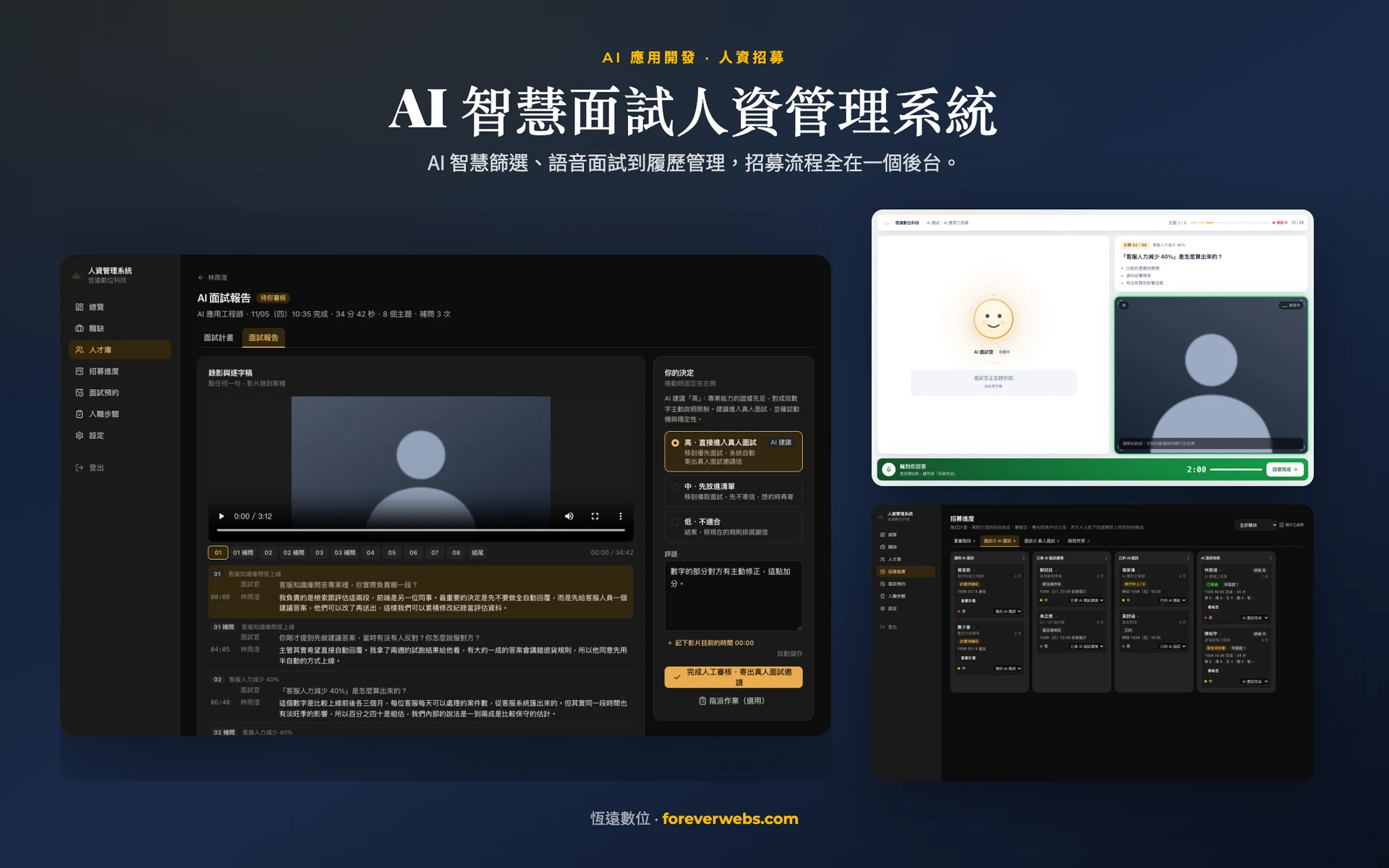
We built this prototype in Traditional Chinese, so the screens are in Chinese.
What was getting in the way
- Resumes come in high volume and uneven quality, so first-pass screening is slow and reviewers apply different standards
- First-round interviews have to fit both sides’ schedules, and candidates get different questions, so they are hard to compare
- Results claimed on a resume are hard to verify, and it often takes an interview with a person to find out the candidate cannot explain them
- Applications, interview times and offer documents are spread across email, notes and calendars, so progress is hard to track
How the system solves it
- An AI application review that suggests a priority based on the job’s requirements and lists highlights and risks, with clear-cut cases decided by rules first
- A voice AI interview that candidates book themselves, with the same shared questions for everyone and resume-check questions generated for each person
- Claims to verify are pulled from the resume and probed in the interview, and the report marks each claim’s status and links to the recording
- Talent pool, hiring board, interview booking, online offers and onboarding checklists in one place, with the full history on each candidate’s page
What is inside
AI voice interviews
The AI interviewer asks questions by voice and follows up based on each answer. The screen keeps the question and a countdown in view, and every session is recorded and transcribed.
AI resume screening
Applications from the website form are checked against the job’s requirements as soon as they arrive, with a suggested priority, highlights and risks. A person makes the final call.
Interview reports and claim checks
A summary, the verification status of each claim and 5 evaluation areas. Click the transcript to jump to the recording, and tick suggested questions to carry into round two.
Talent pool and resume management
Imports resumes from 104 Job Bank through Gmail and collects applications from the website form, with search and filters by job, stage and priority.
Hiring board and interview scheduling
Tabs for application review, AI interview, interview with a person and offer track progress. Candidates book open time slots themselves, synced with the calendar.
Resume manipulation check
Scans the resume PDF and form text first. A PDF with instructions aimed at the AI is not sent to the AI and is flagged for a person.
What changed
- AI interviews of about 45 minutes each; candidates pick their own start time within the next 7 days, in 30-minute steps
- Reports organize the evidence into 5 areas, give no score where evidence is thin, and leave every final decision to a person
- 1,100+ automated tests passing, covering AI interviews, application review and the hiring workflow
How the project came together
The two most time-consuming parts of hiring are reading resumes and running first-round interviews. Resumes come in every format and vary widely, and someone has to read them one by one from the inbox. Interviews have to fit both sides’ schedules, and candidates are not all asked the same questions, so they are hard to compare afterward. We ran into the same problems when hiring for our own team, so we turned our hiring process into software, and our own recruiting now runs on it.
When an application comes in through the form on our website, the software runs an AI review against the job’s requirements, suggests a priority, and lists highlights and risks to check. Resumes from 104 Job Bank (a widely used job site in Taiwan) are imported from Gmail into the talent pool, and a person reviews them. Anything rules can decide is decided by rules first. For example, an application with no resume and fewer than 50 characters about relevant experience is rated low without calling the AI at all. If a resume PDF hides instructions written for an AI, it is not sent to the AI. Whenever manipulation is suspected, none of the AI’s output is filled in, and the application is flagged for a person.
Candidates who pass the review get an invitation, pick their own time slot and check their camera and microphone before starting. An AI interviewer asks questions by voice. Each session takes about 45 minutes and covers 4 questions that verify the resume and 4 questions every candidate gets, with follow-ups based on the answers, up to 3 rounds per question. Afterward, the software produces a report with a summary, the claims that need checking, 5 evaluation areas and suggested questions for the second round. An area without enough evidence gets no score rather than a forced one, and clicking a line in the transcript jumps to that moment in the recording.
Everything the AI produces is a suggestion. The hiring lead reads the report and decides whether the candidate moves on to an interview with a person. Booking those interviews, syncing with Google Calendar, sending offers online and onboarding checklists all live in the same back office.
The screenshots use fictional candidates and job openings. For now, only our own team uses the software. It can be adapted to another company’s hiring process; contact us for details and pricing.
- Next.js
- React
- TypeScript
- Anthropic Claude
- Tailwind CSS
Want a system like this?
Tell us how your process works today. We will scope a version for your team, with a requirements document, a detailed quote and a timeline.