Prototype
Contractor site access and permit-to-work software for industrial plants (prototype)
A prototype for managing outside contractors at an industrial plant: gate access, hazard notices and multi-step sign-off on work permits, connected to gas detectors and gate turnstiles, with hazardous work shown live on a 3D model of the plant.
- Our own prototype, not a client project
- Chemical and manufacturing
- Taiwan
- 2026
- One plant site with 5 work zones
- Prototype, not in use at a client site
- 5-step sign-off on one permit, from application to close-out
- 3 hazardous work permits: hot work, work at height, confined space
- 4 types of field devices on one 3D plant model
Inside the system
We built this prototype in Traditional Chinese, so the screens are in Chinese.
What was getting in the way
- Contractor qualification records sit on paper and in Excel, so expired ones go unnoticed
- Hazard notices are passed around the site for signatures, with no way to check who has not signed or which version they signed
- A work permit needs four or five signatures, and nobody can tell whose desk it is stuck on
- Gas detector readings and permits are separate records, so a reading over the limit depends on someone noticing it
How the system solves it
- A qualification database for contractors and their workers, with reminders 30 days before expiry and a live check when a code is scanned at the gate
- Hazard notices read on a phone after scanning a code and signed by hand, with a new notice required whenever the job or the crew changes
- One five-step sign-off for hot work, work at height and confined space permits, with each step’s progress and waiting time visible live
- Detector readings written into the permit, with work suspended automatically and the safety team alerted when a reading goes over the limit
What is inside
Live 3D plant monitoring
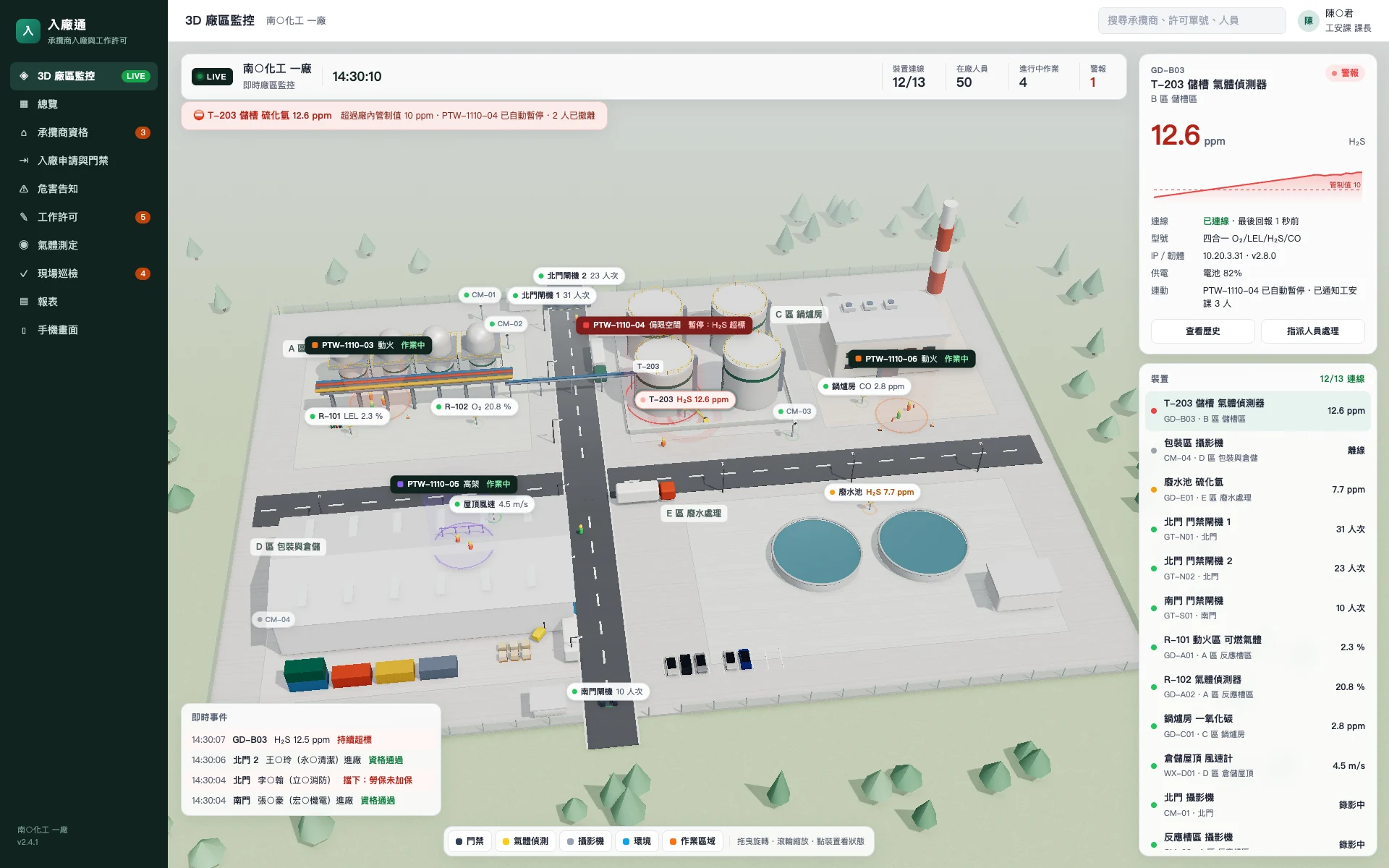
Devices sit at their real positions on the plant model, with live connection status and readings. Click one to see its trend, limits and linked rules.
Contractor qualifications
Labor insurance, safety and health training and specialized work licenses in one place, with expiry reminders. Workers who do not qualify are stopped at the gate.
Entry requests and gate access
Contractors apply online and get an entry QR code once approved. Scanning it at the gate checks both qualifications and hazard notice records.
Hazard notices signed on a phone
Workers scan a code to read the day’s hazards and required precautions, then sign by hand. A new notice is required when the job or the crew changes.
Multi-step permit sign-off
Hot work, work at height and confined space permits share five steps: apply, confirm, test, approve and close out. Every step is recorded.
Inspection findings tracking
Photograph problems on a phone, assign a contractor and a deadline, and keep overdue items flagged in red until they are closed. The monthly report supports contractor reviews.
What changed
- Connection status and readings from 4 device types (gates, gas detectors, cameras and wind speed meters) on one 3D plant view
- 3 paper forms (hazard notices, work permits and inspection findings) turned into online sign-offs with a complete record
- When a detector reading goes over the limit, the related work permit is stopped automatically, without relying on anyone to remember
How the project came together
When a plant brings in outside contractors for maintenance, hot work (welding and cutting) or tank cleaning, that is when industrial accidents happen most often. Contractor crews do not know the site well, and they often do high-risk work. Taiwan’s Occupational Safety and Health Act requires the plant to tell contractors about site hazards before handing over the work, to coordinate everyone on site, and to require a permit before hazardous work starts. In practice, letting contractors onto the site means checking each worker’s qualifications, briefing the crew on hazards and issuing permits for dangerous jobs. Many plants still do this on paper: certificates are photocopied and filed, hazard notices are passed around the site for signatures, and a single hot work permit needs four or five signatures. Only the people on the floor know who is working in which area right now.
We built this software as our own prototype. It puts every step, from vetting a contractor to closing out the job, in one place. Contractors apply online to enter the plant. The software checks each worker’s labor insurance (Taiwan’s national insurance program for workers), general safety and health training, and licenses for specialized work, and sends a reminder 30 days before any of them expires. Anyone who does not qualify cannot get through the gate turnstile. Hazard notices move to the phone: workers scan a code, read the notice and sign by hand on screen, and nobody starts work until they have signed.
Hot work, work at height and confined space permits share one multi-step sign-off: the contractor applies, the site supervisor confirms, gas levels are tested, the safety manager approves, and the job is confirmed closed at the end. Each step records who signed and when. Gas detector readings go straight into the permit, and when a reading goes over the plant’s own limit, the software suspends that permit and alerts the safety team.
On the management side, the whole plant appears as a 3D model. Gate turnstiles, gas detectors, cameras and wind speed meters sit at their real positions, and each device’s connection status and readings update live. Click one to see its trend, its limits and the rules linked to it. Hot work, work at height and confined space jobs in progress are marked on the plant as highlighted zones, so anyone can see at a glance who is working where.
During site inspections, safety staff photograph problems on their phones and assign each one to a contractor with a deadline. Overdue items turn red and are tracked until they are closed. A monthly report counts permits, sign-off times and inspection findings, and can serve as the basis for each contractor’s annual review.
Other systems we have built
Want a system like this?
Tell us how your process works today. We will scope a version for your team, with a requirements document, a detailed quote and a timeline.